Review: Papa’s Mechanical Fish

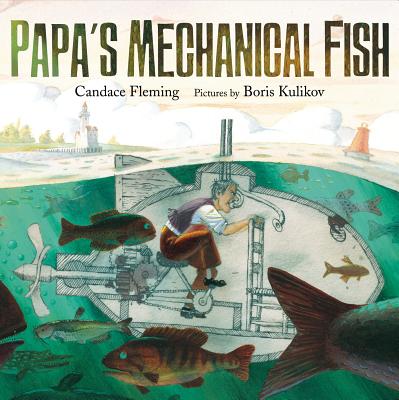
Papa's Mechanical Fish coverPapa’s Mechanical Fish

Written by: Candice Fleming

Illustrated By: Boris Kulikov

Farrar, Straus, Giroux Books for Young Readers, 2013, Hardcover

Target Audience: Ages 3-8

Genre: Fiction

Theme: Creativity, Persistence

How We Discovered This Book: This is another fiction book based on a real person’s story. You can read my previous review for a book of the same type, called Building Our House.

Summary:

Papa loves to invent things and solve problems, so one day when his daughter asks, “What would it be like to be a fish?” he goes into his work shop and doesn’t come out until he has a prototype. He tests idea after idea, until finally one works.

What I Liked:

I liked that Papa has not invented anything that works, but he still sticks with it. The story is told in a rhythm similar to a song- there is plot, and then a “refrain.” In the refrain, each family member comments on the events. The manner in which each person talks tells us so much about each character. In most cases, it is the only way we find out what the characters are like.

What Did My Kids Think?

They liked Papa’s creativity, and that his family was so willing to support him even when his solutions seemed silly. Similarly to Building Our House, there is a page in the back that describes the real man that inspired the story- my kids love this kind of real life reference. An inventor named Lodner Phillips created his own submarine in 1951, which made significant improvements on existing submarine designs including steering, an air purifying system, and a boiler than generated steam underwater to run the engine. His family actually went out into Lake Michigan with him in his invention.

Resources:

As suggested on Celeste Reads, you could have children brainstorm their interests, talents, passions, or hobbies in a journal. They can then set a realistic goal (with help), set a timeline, and when the time has passed you can have a presentation day to see what they did and what they learned.

Sit down with some art supplies and paper, and brainstorm some things you’d like to see be invented. And then draw as many as you can!

Review: Building Our House

Building Our House Cover PageBuilding Our House

Written and Illustrated by: Jonathan Bean

Farrar Straus Giroux Books, 2013, Hardcover Edition

Target Audience: Ages 3-8

Genre: Fiction

Theme: Creativity/Family

How We Discovered This Book: This book was in the new books bin at our library, and it looked like good choice for my kids who are very much interested in how things are made.

Summary:

A girl and her family pack up their belongings and move from town out into an empty field. They live in a trailer for 1-1/2 years as they build their own home from scratch. Every member of the family has a part to play in the hard work and love it takes to build a home.

What I Liked:

Given the increased focus on non-fiction books in our schools, I’m very interested in books that take a non-fiction topic and put a twist on it. This is a fiction book, but is factually based on real events and a real building process. Rather than make it a dry book about construction, the author intertwines the family story with all of the work they did to build their own home. Kids will learn, without really being aware they are learning.

What Did My Kids Think?

Both of my kids enjoyed this book, and I think they now have a slightly better appreciation for what it has taken for us to renovate our own house. They had lots of questions that extended the discussion into other books and videos. The whimsical illustrations pair nicely with the story. The author includes some of his parents’  photographs from their house building at the end, which is an extra treat.

Resources:

PBS has a fun activity where kids can measure and build a house for some of their favorite storybook characters.

Scholastic has an activity focused on the business process from plans to completion.

Improvise, and see what other kinds of houses you can build: birdhouses, gingerbread houses, or even a house for your guinea pig.

Review: The Pirate’s Parrot

The Pirate’s Parrot

Written by: Lyn Rossiter McFarland

Illustrated By: Jim McFarland

Tricycle Press, 2000, Hardcover

Target Audience: Ages 3-8

Genre: Fiction

Theme: Bravery, Strength

How We Discovered This Book: This book has been on my “To Read” list for a while. I believe Joanna recommended it to me. We borrowed it from our library.

Summary:

Captain Cur’s parrot dies, and his monocle is stepped on. How can he be a proper pirate captain without them? His crew finds him a replacement parrot, who is really a stuffed girl teddy bear. The crew teaches her to be a proper pirate, who bites, spits, swashbuckles,  and perches on the captain’s shoulder. But she proves she’s really a proper pirate when they encounter another pirate ship and she saves the day.

What I Liked:

This book is funny, and is immensely fun to read aloud. My kids thought my teddy bear and pirate voices were hilarious. Who doesn’t love to do a good pirate voice?

What Did My Kids Think?

Both of my kids enjoyed the story. My son liked that it was different from other pirate stories. He thought the funniest parts were when the bear talked and tried to be a pirate. In simplest terms, TEDDY BEAR + PIRATES + HUMOR = GOOD STORY in our house.

Resources:

In searching for resources related to this book, I discovered that the mascot for the Pittsburgh Pirates major league baseball team is called the Pirate Parrot. Go figure.

Pirate Crafts, Coloring, and Printables

Declare it Pirate Day in your house: Dress up like pirates (a scarf, a striped shirt, a belt, and a quick paper eye patch will do), talk like pirates, and use your imagination to turn your couch into a pirate ship set for plunder.

Whether it’s Talk Like a Pirate Day (September 19th) or not, you can always integrate pirate-based lessons into your classroom.

Book Recommendations for Children 1 Year Old and Under

One of our critique group members recently became a grandma, so we were discussing our favorite books for very young children. Each of our personal lists brought back many memories, and we ended up with a solid list of quality books. So we thought we’d share them with you!

Here are our favorite books for children 1 year old and younger, in alphabetical order by author:

Hug, Jez Alborough

Sandra Boynton Books– including Pajama Time; Blue Hat, Green Hat; Moo, Baa, La la la!; Barnyard Dance!

The Very Hungry Caterpillar, Eric Carle

Click, Clack, Moo: Cows That Type, Doreen Cronin and Betsy Lewin

Are You My Mother? P.D. Eastman

Time For Bed, Mem Fox

Orange Pear Apple Bear, Emily Gravett

Cowboy Small, Lois Lenski

Brown Bear, Brown Bear, What Do You See?/ Panda Bear, Panda Bear, What Do You See? Bill Martin and Eric Carle

Guess How Much I Love You, Sam McBratney

Blueberries for Sal, Robert McCloskey

Good Night Gorilla, Penny Rathmann

Richard Scarry’s Best Word Book Ever, Richard Scarry

I Am A Bunny, Richard Scarry

Sheep in a Jeep, Nancy Shaw and Margot Apple

I Love You Through and Through, Bernadette Rossetti Shustak

Hop on Pop, Dr. Seuss

Owl Babies, Martin Waddell

That’s Not My Puppy/ That’s Not My Car/ That’s Not My Dinosaur, Fiona Watt and Rachel Wells

Knufflebunny, Mo Willems

Goodnight Moon, Margaret Wise Brown and Clement Hurd

Runaway Bunny, Margaret Wise Brown

Do have other favorites not on this list? Please share!

When Books are Made into Movies

Recently, me and my children read a few books together that were eventually made into movies. We read the books first, and then we watched the movies. I’m a believer that most books are better than their movie counterparts. It is nearly impossible that the images I create in my mind can be recreated on screen. However, a movie adaptation still has a chance to wow me. If it makes a very literal translation to the screen, then the movie might be okay. But if the movie brings something new to the interpretation of the material- a new perspective, a creative visual twist, the intriguing portrayal of a highly complicated character- I might enjoy the movie just as much as the book.

The first book we read was The Borrowers, by Mary Norton. It is the story of a family of tiny people who live under the floor of a house. A teenage girl named Arrietty lives with her mom and dad under the kitchen. They “borrow” just what they need, and only those things the residents won’t miss. It was published in 1952 (and won the Carnegie Medal and other awards) but it has a timeless quality to it. There were several movies made from this book, including an American live action version with John Goodman. The movie we saw was The Secret life of Arrietty, which is a 2010 Japanese anime film dubbed in English.

We enjoyed both the book and the movie. It is a fanciful story, but set in everyday environments. It draws on a common human premise: where do things go when I can’t find them? The movie was different in many details and subplots from the book, but it deftly visualized the core elements. Each of the characters was presented slightly differently, but in most cases the changes smoothed over parts of them that I found mildly annoying in the book. For example, Arrietty’s mother is whiny and neurotic in the book, which is switched to concern and worry for the well-being of her family.

The second book we read was Holes, by Louis Sachar. This book tells the story of Stanley Yelnats, a boy who is always in the wrong place at the wrong time. He gets sent to a juvenile detention camp in the desert, where each boy is tasked with digging a large hole each day. It was made into a movie in 2003 with Shia LaBeouf in the lead role. The movie sticks fairly close to the book, but changes some of the details. My son was wondering why some parts of the movie felt so different from the book. The book is written in first person, from Stanley’s perspective. We get to hear his thoughts directly – how he feels about a situation, what he worries about, etc. I explained that if they directly translated it, we would be spending a lot of time watching Stanley think, or listening to an annoying voiceover. The film makers chose to use the parts of the book that had the most visual potential, and focused on those.

I especially enjoyed this book. There were details thoughout the book that seemed to be character or setting description. When you get to the end, you realize that everything the other has included is important to the resolution of the story. As a writer, I was amazed at how tight the writing was, while being so descriptive and creative,

I was also interested to see how each of these books were adapted, given that The Secret World of Arrietty is screenwritten by someone other than the author. The screenplay for Holes was written by the author, Louis Sachar. I was impressed with the restraint he showed with the source material, only including the parts that would best tell the story on screen. I was also impressed with his ability to write a screenplay, which to me requires a different skill set than writing a novel.

I would recommend both of these books and movies. Me and my kids are so enjoying this process, I think we’ll keep it going. We have already read Charlotte’s Web and seen the movie. I’m waiting until they are older for necessities like Harry Potter and Lord of the Rings. Any recommendations for other book and movie combos? Please share in the comments!

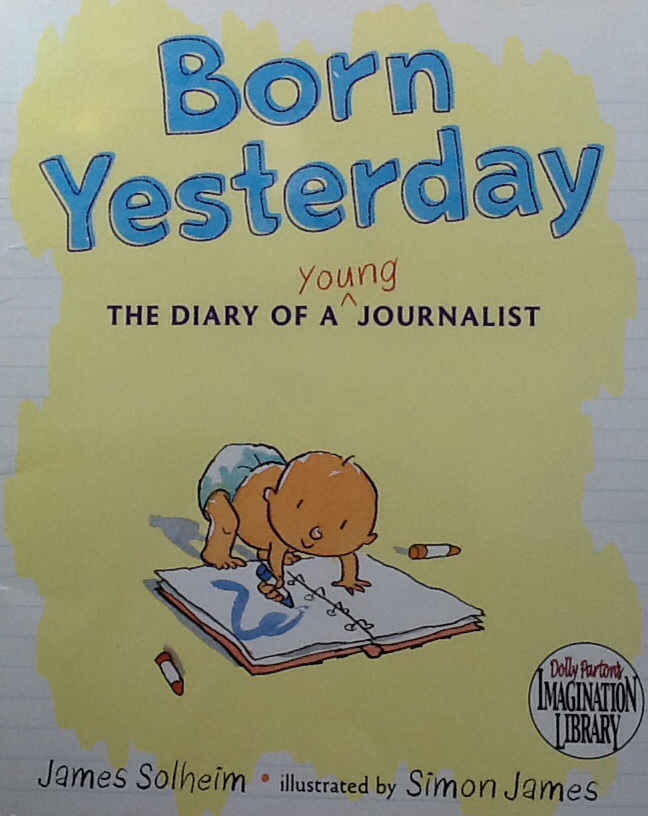
Review- Born Yesterday: The Diary of a Young Journalist

imageBorn Yesterday: The Diary of a Young Journalist

Written by: James Solheim

Illustrated By: Simon James

Philomel Books, 2010, Imagination Library Edition

Target Audience: Ages 3-8

Genre: Fiction

Theme: Growing up, Siblings

How We Discovered This Book: My son received this as his monthly Imagination Library book a few years ago. It is a favorite in our house, and is on frequent rotation. For more information on the Imagination Library, you can read my previous post.

Summary: A baby shares his very funny and astute observations of the world.

What I Liked: The voice in this book is very strong, and hilarious. Right on the first page, the baby talks about being born and says,”If I’d known I was going to be born in public, I’d at least have put on a tank top.” You might think that nothing really happens in a baby’s life, but this story manages to have a main arc and sub plots while still remaining simple. This author has chosen his words immensely well.

What Did My Kids Think? This books cracks us up every time. My son thinks the baby’s observations and the book’s illustrations are so funny. And who wouldn’t laugh at a dog named Foofy?

Resources:

Journaling: Children of all ages can be encouraged to journal. Both of my children have journals, which we take with us on all of our adventures. My daughter just scribbles at her age, but I like the idea that Aidan is modeling how to put thoughts and ideas on paper.

Writing activities: Scholastic has some good suggestions for using this and other diary books to inspire children to write.

Journalism: Talk about what a journalist is, and what they do. Help the child brainstorm about what they would report on if they were a journalist. Have them pick a topic, research it, and then write the story. This can also be a springboard to a multimedia project where they can be a TV journalist, planning and filming their report.

What Are You Reading?

As a children’s book writer and a mother of 2 young kids, I read a ton of children’s books. We add a new batch of picture books to our reading list each week when we visit the library, and the kids eagerly expand their personal libraries when they get bookstore gift cards. I have a long list of “want to read” books, which include new books that have been recommended and classics that somehow escaped my childhood education.

My son and I are slowly working our way through the chapter books and young novels on the list, reading a few chapters each night together. We just finished The Borrowers (which my daughter also liked listening to), and now we are on to Holes. I like when there is a film version to show them afterwards. It results in some lively discussions about how the version on screen is similar of different than what they had built up in their minds. The Japanese anime movie The Secret Life of Arrietty is based on The Borrowers, which we’ll watch next week.

With all of these children’s books to read, sometimes I want a break to return to the adult world of literature. I have a big stack of writing craft books and a Jim Henson biography waiting for me, but my go-to books help me escape to somewhere else entirely. My favorites are fantasy, science fiction, and suspense/thrillers/crime.

Sometimes the categories blur a little between adult and young adult, like in the case of Harry Potter, Eragon, and The Lord of the Rings (all of which I absolutely loved). I just finished a Terry Pratchett novel called Snuff, featuring the complex and tell-it-like-it-is Commander Sam Vimes. Terry Pratchett is a comic fantasist, weaving dry humor, social commentary, and human nature into his Discworld novels. I have thoroughly enjoyed nearly everyone of his books, and his characterization of Death cracks me up every time.

I’m starting J.K. Rowling’s book, The Casual Vacancy, and then I’m on to some crime novels. I especially like Swedish crime novels right now (like Three Seconds), which I got interested in after reading The Girl With the Dragon Tattoo trilogy. Luckily, I’m a fast reader, because there are so many more books I want to read!

What are you reading right now? Who are your go-to authors? Please share your suggestions… I’d love to keep supplementing my list with good recommendations!

Image

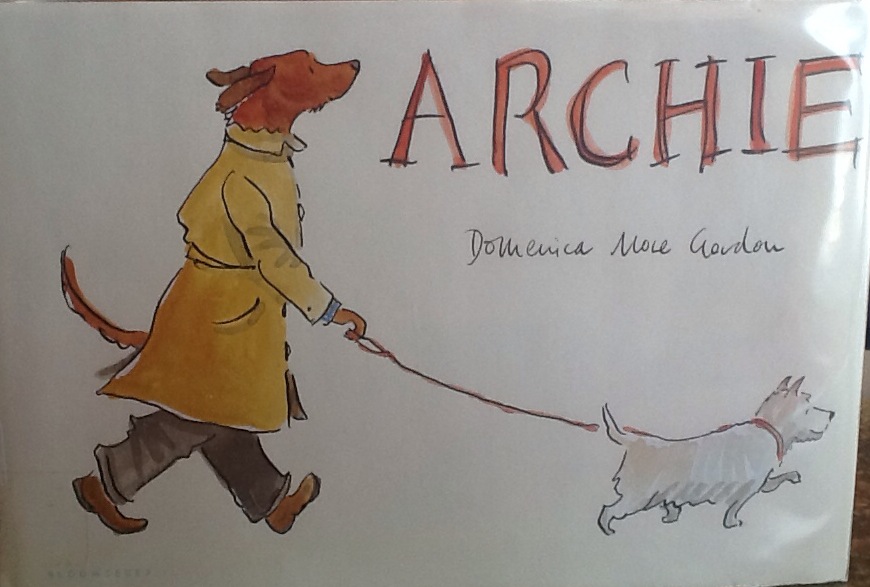
Review: Archie

Archie CoverArchie

Written and Illustrated by: Domenica More Gordon

Bloomsbury Books for Young Readers, 2012, Hardcover Edition

Target Audience: Ages 3-8

Genre: Fiction

Themes: Trying something new, following your dreams, self-confidence

How We Discovered This Book: My son chose this book during media class, and brought it home from the school library.

Summary:

Archie decides to make his dog some new clothes. Soon, they are the talk of the neighborhood and everyone wants cute clothes for their dogs too.

What I Liked:

This book is wordless, which is not usually the type of picture book I gravitate towards. However, the story flows along nicely without the words, and my kids could follow along without any explaining from me. The illustrations are charming and minimal.

What Did My Kids Think?

My kids are very interested in animals right now, so a book full of dogs is very appealing. They find it funny that dogs would have dogs as pets. My astute son even noticed that all of the dogs in the story have the same type of dog as they are (a boxer has a boxer as a pet, for example), except Archie. He appears to be a lab type dog, while his pet is a terrier. Curious…

Resources:

There are no existing resources for this book, so I’ll get a little creative this time.

The author is an artist known for her miniature felt dogs. Check out a story here about her dogs and the inspiration for the story.

There is another Archie book, Archie’s Vacation, which we have not yet read.

If you have dogs in your life, maybe you think they need some cuter clothes themselves? There are plenty of instructions on pet clothing and other related projects.

Maybe you really like the illustrations, and would like to try your hand at drawing a dog.

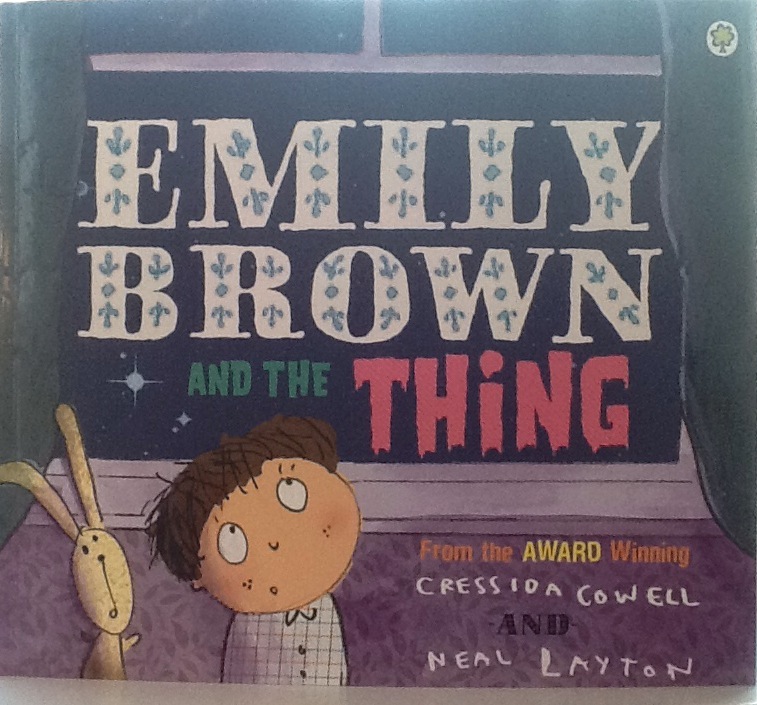
Review: Emily Brown and the Thing

ImageEmily Brown and the Thing

Written by: Cressida Cowell

Illustrated By: Neal Layton

Orchard Books, 2007, Paperback Edition

Target Audience: Ages 3-8

Genre: Fiction

Theme: Bedtime

How We Discovered This Book: My kids and I absolutely loved That Rabbit Belongs to Emily Brown, another book by Cressida Cowell. You can check out my previous review. I had heard there were other Emily Brown books, so at Christmas time I went searching for them. I discovered 3 more! In addition to Emily Brown and the Thing, there is Cheer Up Your Teddy Bear, Emily Brown, and Emily Brown and the Elephant Emergency.

Summary:

Emily Brown and her trusty stuffed rabbit Stanley are trying to sleep. But the Thing has other plans. He makes all kinds of noises, and the only way to get him to be quiet is to help him. He needs his cuddly, his bedtime milk, his medicine… will he ever go to sleep?

What I Liked:

This resonated on a variety of levels, for both me and my kids. Emily is not scared of the Thing. She is brave and in charge (as always), taking on each challenge with a smile. In the end, she even tucked him into bed (under her bed, no less). The whole story reminded me of my children, and the “needs” they come up with to stall going to bed.

What Did My Kids Think?

They thought the book was funny and creative. They love Emily’s imagination- she didn’t just find his medicine, she put on her special glasses, climbed through the Witches’ Cavern, and told the witches stories in exchange for the medicine. And her answer to the Thing when he says his leg itches is just priceless (and familiar?)

Resources:

Hatchette Children’s Books has free activity downloads for Emily Brown, including a door hanger and idea prompts.

Review: The Fox and the Falling Leaves

FoxThe Fox and the Falling Leaves (originally titled Fletcher and the Falling Leaves)

Written by: Julia Rawlinson

Illustrated By: Tiphanie Beeke

Scholastic Books, 2006, School Paperback Edition

Target Audience: Ages 3-8

Genre: Fiction

Theme: Transformation, Caring for Nature

How We Discovered This Book: Several times a year, my daughter’s preschool sends home a Scholastic flyer with suggested books for purchase. This one looked like a good addition to our library for the fall.

Summary:

Fletcher the fox has a favorite tree, but one day he is disturbed to find that it is losing all its leaves. He tries to help it keep its leaves, but he cannot stop the inevitable. Then he discovers something beautiful when all the leaves are gone and the air turns cold.

What I Liked:

Fletcher is adorable (both in illustration and in text), and his eagerness to “save” his favorite tree is very sweet. Several animals try to take the fallen leaves for their winter nests, and Fletcher is distraught. He even takes the last leaf into his den to protect it.

What Did My Kids Think?

Elizabeth liked Fletcher, especially since he is a little animal (anything smaller/younger than her makes her giggle). She liked that she figured out what was going on with the tree long before Fletcher did. She felt very smart.

Resources:

Scholastic has a study guide for this book with discussion questions, activities, and other stories about the seasons and nature.

The Activity Idea Place has links to a huge list of crafts, activities, games, field trip ideas, snacks, and songs… all around the theme of leaves.