Review: That Rabbit Belongs to Emily Brown

This week I thought I’d share one of my children’s all time favorites. It may be a little hard to find, but I found it at both my library and through used book sellers.


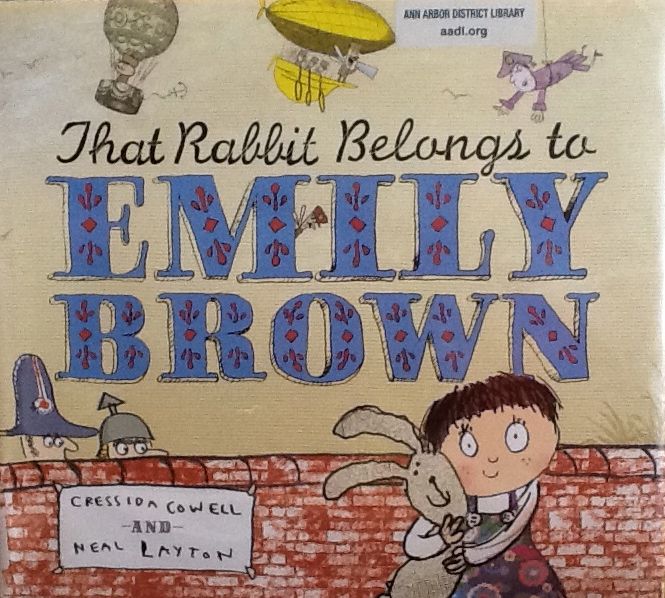
That Rabbit Belongs to Emily BrownThat Rabbit Belongs to Emily Brown

Written By: Cressida Cowell

Illustrated By: Neal Layton

Orchard Books, 2007, Hardcover Version

Target Audience: Ages 3-7

Genre: Fiction

How We Discovered This Book

I happened to borrow this book from our library based on the cover art, and my children and I fell in love with it. I tracked down a used copy for our home library.

Summary

Emily Brown goes everywhere with her bunny, Stanley. They have all kinds of adventures: in space, in the Amazon rain forest, and many other places. The Queen decides she wants a toy as nice as Stanley. In fact, she wants Emily Brown’s bunny. Now.

What I Liked

The story is told with much creativity and humor. The illustrations not only complement the story, they have many additional details waiting for a perceptive child to find. The writing is so tight and critical to the story, you feel as if Ms. Cowell chose every word very carefully. There are no extra words in this story, but it doesn’t feel spare, either. We quickly know what Emily Brown is all about without much text.

What Did My Son Aidan Think?

Both my son and my daughter love this book. We currently read it at bedtime 3-5 times a week. They each have their favorite parts that they recite during the storytelling. Aidan’s favorite part (and mine) is when Emily Brown corrects the Queen’s military men, sent to get the bunny: “This rabbit is NOT for sale. And his name is NOT Bunnywunny. It’s Stanley.” My daughter loves when the men offer Emily ten talking dolls that say “Mama, Mama.”

Resources

If you enjoy this book too, and would like have more fun with it, here are some resources to check out:

Lesson Plans (Lesson 2)

Emily Brown Activity Sheets

Discussion Topics

New Review Format & The Legend of the Candy Cane

Welcome to 2013 everyone! As we begin this new year, we’ll be introducing some new types of posts to keep things interesting. You’ll see more regular book reviews, writing challenges, and perhaps even some interviews. We’re also open to suggestion, if there is something you would like to see us discuss. Feel free to post your thoughts in the comments.

We have included book reviews before, but I thought they could use a little more regular formatting. So here goes…


The Legend of the Candy CaneThe Legend of the Candy Cane

Written By: Lori Walburg

Illustrated By: James Bernardin

Zondervan Publishing House, 1997, Hardcover Version

Target Audience: Ages 4-8

Genre: Fiction

How We Discovered This Book

This book was read by my son’s teachers in religious instructions class. He liked it so much that he borrowed it from his school library.

What I Liked

The story is a charming tale of a possible meaning behind the creation of the candy cane. The story is religious in nature, but the story flows so smoothly, it feels more like a winter or Christmas book than a religious one. I am fascinated by mythology and the stories we create to explain those things that we don’t completely understand, so this story certainly appealed to me. The illustrations mirror the old-fashioned feel of the story.

What Did My Son Aidan Think?

Clearly, this book made an impression on Aidan for him to seek it out at the library. He also liked the illustrations, but his favorite part was that the story was about candy. Candy canes are the feature, but many other kinds of candy are a part of the story. Each time we read it, I think he drooled over the possibilities.

What Beautiful Illustrations Can Do

In my personal development as a picture book writer, I fully admit that one of the first things I had to learn was to let go of what the book would look like. It is extremely tempting to include copious notes, in hopes that an illustrator will create pictures that mirror EXACTLY what the writer sees in their head. This is the writer’s story, after all, is it not?

You could take this limited view, but you would be missing out on many wondrous possibilities. What if the illustrator creates a vision of your book that is far beyond anything you imagined? What if they elevate your words, creating images that supplement, partner, or even transcend what you have written?

I was not always a believer. Then recently I read two picture books that demonstrate how an illustrator working with a writer’s words can elevate the piece to something quite special.

The first example is an author/illustrator. You may say, “Well, that doesn’t count. He’s working with his own story.” I would agree that it may guarantee that the writer’s vision is illustrated the way he sees it. However, it does not guarantee that the resulting words and pictures work together to create something that is greater than the individual pieces.

Lane Smith, is well known for illustrating for others, such as Jon Scieszka’s The Stinky Cheese Man. He has also illustrated his own books. My favorite of his own stories (that I have read so far) is Grandpa Green. Grandpa Green’s great-grandson tells his grandfather’s story, as he wanders through a garden. The garden is full of topiaries and other garden creations that show each of the memories that the boy shares. For example, Grandpa got chicken pox: “He had to stay home from school. So he read stories about secret gardens and wizards and a little engine that could.” These words are accompanied by a two-page spread of bushes and trees cut to resemble a lion, a scarecrow, a tin man, and a train. In the end, you discover that Grandpa is old and sometimes forgets things. “But the important stuff, the garden remembers for him.” We are treated to another two-page spread of all of the garden creations, made by Grandpa himself.

Besides the beautiful illustrations throughout the book (made all the more amazing by the fact that he uses the color green almost exclusively), the story itself is sweet. But when you combine the story and the illustrations together, it lifts up the book to make it poignant, charming, and endearing. The pictures reinforce the words, and give them so much more meaning. My son and I were so taken with the book that we immediately went back to the beginning and read it again. I was pleased to discover that Grandpa Green has earned Lane Smith the 2012 Caldecott Honor.

The second example is Two Little Trains, by Margaret Wise Brown and illustrated by Leo and Diane Dillon. The first item of note with this book is that it was published in 2001, 49 years after Ms. Brown’s death. More amazing still, there are many more of Margaret Wise Brown’s books that have been published posthumously with modern illustrators.

In Two Little Trains, Ms. Brown uses techniques seen in other books of hers: a repetitive, rhythmic language that compares and contrasts objects and concepts. For example:

One little train was a streamlined train,

Puff, Puff, Puff to the West.

One little train was a little old train,

Chug, Chug, Chug going West.

The words themselves are fun to read, and would be enjoyable to young children. However, the illustrators have taken the text to another level. On each left hand page is a drawing of a real train, making its journey. On each right page is a drawing of a toy train, making its own journey through the house. As the real train zooms along the metal tracks, the toy train runs along its own improvised track made from the fringe of a rug. Again, the illustrators have elevated the words to create a much bigger, more nuanced story. The illustrations ensure you want to turn the page and see what will happen next.

I apologize for not sharing more images (since I am talking about illustrations after all), but I have left them out for fear of using images that do not belong to me. All the more reason for you to go to your library or bookstore and search out these beautiful books for yourselves!

What books do you love, that combine illustration and text in a wondrous way?
Stories Revisited

Do you know the Stinky Cheese Man? The Stinky Cheese Man? The Stinky Cheese Man? (okay, that tune really belongs to the Muffin Man, but you get the picture.)

I don’t know how we missed each other over these last ten years, but I recently met the Stinky Cheese Man. He and some of his friends pop by for a visit in The Stinky Cheese Man and Other Fairly Stupid Tales, by Jon Scieszka.

I had previously read some of Jon Scieszka’s Trucktown stories (which honestly, I’m not that fond of), and was pleased to discover this book. On full display here is Mr. Scieszka’s sharp wit and humor. Combined with Lane Smith’s oddball illustrations, there is much to read and look at in this book.

Personally, I would be hard pressed to attempt to retell a well-known fable or fairy tale. One of my critique group partners is working on a retelling of Rumpelstiltskin. I applaud her for taking on this challenge. She is braver than I.

I borrowed The Stinky Cheese Man from the library to read with my son. We both loved it, and have read it nightly. Unfortunately, now it has to go back.

The tales are creative (Cinderumpelstiltskin, the Other Frog Prince, and The Princess and the Bowling Ball for example), and some are so wrapped up in Jack’s attempt at putting together of the book (another interesting feature) that they never really get told (Little Red Running Shorts, Chicken Licken).

What was amazing about this book was that not only did I enjoy reading it repeatedly (and honing my many story voices, I might add), but both my son and I thought it was very funny. Mr. Scieszka uses wit and child humor without being gross or morally questionable. As a bonus, my son now knows the components of a book with certainty, because Jack takes us along as he assembles the book. The fact that the Table of Contents falls on some of the characters helps as well.

In looking at the Scieszka book list on Amazon, I apparently have missed quite a few other books that my son and I might enjoy. We’ll have to try The True Story of the 3 Little Pigs or Squids Will Be Squids.

Do you read Jon Scieszka books? Which are your favorites?

School Is Out!

As the doors swished closed on the bus and my son waved goodbye, my eyes filled with tears. It took me completely by surprise. I hadn’t expected his last day of Kindergarten to be so emotional. Perhaps it’s because he has grown so much in this last year. Blossomed, really. He started the school year as a little boy, and now he is a BOY. A boy full of questions, creativity, and energy.

This week is our first full week of summer break. For us, that means I have both kids at home with me, and we have days full of “after schooling” (additional activities and learning in focus and interest areas), nature walks, swimming lessons, bicycle riding, and playing. And reading. Lots and lots of reading.

Our community has some good reading programs. My son participates in his elementary school program, as well as the one at our local library. Each week, we visit the library to play, do some crafts, return our bagful of books, and borrow a new bagful. So what are we reading to start the summer?

My son: Lots of reading together and reading out loud

The Magic Treehouse series by Mary Pope Osborne

Anything Dr. Suess

That Rabbit Belongs to Emily Brown, Cressida Cowell

We Are in a Book, Mo Willems

The Good Little Bad Little Pig, Margaret Wise Brown

My daughter: lots of reading together- lots of books with pictures!

The Runaway Bunny, Margaret Wise Brown

Bunny Eats Lunch, Michael Dahl

Moonbear, Frank Asch

The Very Hungry Caterpillar, Eric Carle

All of Baby Nose to Toes, Victoria Adler

Big Bird’s Guessing Game About Shapes

Me:

The Hunger Games Trilogy, Suzanne Collins

Ford County Stories, John Grisham

Inheritance, Christopher Paolini

Lots of books to read, and fun to have. I hope you and your families have fun this summer, both inside books and outside exploring!

Creating Something New

My son and I read a sweet story last week: Lissy’s Friends written and illustrated by Grace Lin.

Cover of

Cover of Lissy’s Friends

It is the story of Lissy, the new girl at school. That probably sounds familiar. However, the twist in this story is that to deal with knowing no one, Lissy creates some friends – from origami paper. She starts with a bird fashioned from the school menu, which she appropriately names Menu. Lissy creates many more animal friends, until a playground mishap blows these paper friends away to Paris.

Other children have been watching, and they want to make origami too. Lissy makes new school friends by sharing a talent special to her – origami. She finds new friends on her own terms.

I know a little about origami. My father makes origami boxes and animals to delight his children and grandchildren. He has given me several origami kits over the years, which I have used to make some basic origami animals. See one of my son’s creations at the bottom of this post.

Origami reminds me of the creative process, as well as the revision process. Origami begins with just paper (albeit, colorful paper); paper that is two dimensional and flat. With a few folds, it is turned into something that has a life of its own. A story has similar potential. It can start with an idea, and grow into something that has a life of its own.

It can be scary to revise, especially if you consciously notice the story changing. But if you allow the process to take the story where it wants to go, the results can be amazing. Your story sometimes goes where you never thought it would, and it is a much richer, more interesting story after the journey.

How do you create something transformational in your writing, or in other creative pursuits?

I would also like to give a plug to the program that brought Lissy’s Friends to my family. Both of my children have participated in Dolly Parton’s Imagination Library. It is a program that brings a new, age-appropriate book to preschool children in their homes each month until they turn five. Our local United Way sponsors Imagination Library in our area, and my children love receiving a book in the mail addressed to them. They can’t wait to see what stories each new book has to tell!

Make Me Laugh

Mo Willems is hilarious. Didn’t you know?

Knuffle Bunny: A Cautionary Tale

Knuffle Bunny: A Cautionary Tale (Photo credit: Wikipedia)

My son and I began our introduction to Mo Willems with Knuffle Bunny: A Cautionary Tale, and Don’t Let the Pigeon Drive the Bus. Both books were charming and funny. In Knuffle Bunny, Willems employs a creative use of photography along with the drawn characters. In short, we love these books. I enjoyed buying these books to add to our permanent collection.

Now that Aidan is in Kindergarten and has begun reading on his own, we’ve started reading Mo Willems’ easy readers together. Our favorites are the Elephant and Piggie series. With basic drawings of the characters (no watercolors or elaborate Jan Brett-style illustrations), you are able to focus on the story. Is the story simple? Yes. Is it witty and hilarious? Absolutely!

These books make both of us laugh out loud. When we read Can I Play Too? my son giggles when Gerald and Piggie try to play catch with a snake, and repeatedly bonk him on the head. I laugh when Piggie raises an eyebrow to figure out who is “reading them” in We Are in a Book!

Cover of

Cover via Amazon

In short, we are convinced he is a genius. He manages to create expressive, witty characters with just a few well placed lines. His stories are simple, to-the-point, joyful, funny, and make you want to read them again and again.

Additionally, I researched Mo’s background and discovered he formerly wrote for Sesame Street (which earned him multiple Emmys). I’m sold. Anyone who works with the likes of Bert, Ernie, Knuffle Bunny, and the Pigeon is cool in my book. Now if I can just find a way to capture even an ounce of his humor in my stories.

What authors make you laugh? What is it about their books that tickles your funny bone?